Look-Alike Flags: 10 Pairs and How to Tell Them Apart
Chad or Romania? Indonesia or Monaco? Ten sets of flags that look almost the same, the one detail that tells each apart, and why so many flags look alike.
Some flags are easy. Japan, Canada, Brazil: one glance and you know. Others are a trap, because somewhere else in the world there is a flag that looks almost exactly the same. Flag quizzes love these pairs, and so do we.
Here are ten sets of look-alike flags, what makes each one different, and a few habits that help you get them right every time.
Why so many flags look alike
Most look-alikes are not a coincidence. Countries with a shared history or a shared idea often chose the same colours on purpose, and these "flag families" explain a lot of the confusion:
- Pan-African colours: green, yellow and red, inspired by the flag of Ethiopia, a symbol of independence for much of Africa. Ghana, Senegal, Mali, Guinea, Cameroon and many others use them.
- Pan-Arab colours: red, white, black and green, which go back to the flag of the Arab Revolt of 1916. Egypt, Jordan, Palestine, Sudan, Syria and Iraq all draw on them.
- Pan-Slavic colours: white, blue and red, taken from the flag of Russia and adopted by Slavic movements in the 19th century. Serbia, Slovakia, Slovenia and Croatia use them.
- The Nordic cross: Denmark's flag, often called the oldest national flag still in use, gave its off-centre cross to Sweden, Norway, Finland and Iceland.
Once you know the families, look-alike flags stop being random. You only need to learn the one detail that sets each member apart.
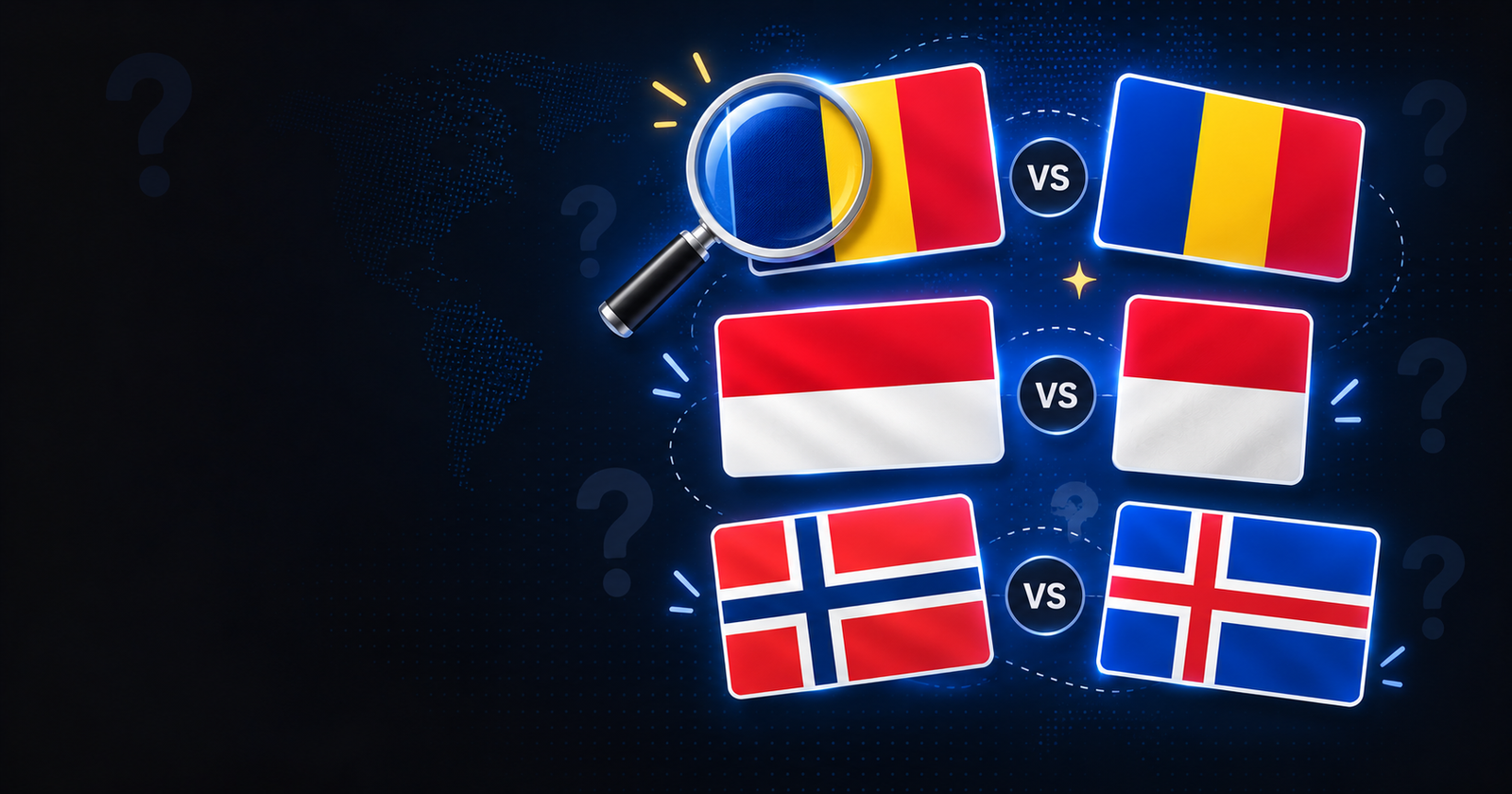
1. Chad and Romania
This is the closest match of all. Both flags are vertical stripes of blue, yellow and red, in the same order and the same proportions. The only difference is the shade of blue: Chad's is a darker, deeper blue, while Romania's is a brighter cobalt.
Side by side you can just about see it. On its own, without the other flag to compare against, even experts hesitate. In a quiz, the best clue is usually the context: if the question is about Africa, think Chad; if it is about Europe, think Romania.
2. Indonesia and Monaco
Two horizontal stripes, red on top and white below. The difference is the shape: Indonesia's flag is longer (2:3), Monaco's is closer to a square (4:5). The colours are near enough identical.
And just to make it harder, Poland uses the same two colours the other way round: white on top, red below. A simple way to remember it: Poland's white is on top like snow on a mountain.
3. Ireland and Côte d'Ivoire
Both are vertical stripes of green, white and orange. The order is reversed. Ireland has green next to the flagpole, then white, then orange. Côte d'Ivoire starts with orange next to the pole, then white, then green.
One trick: Ireland is famously green, so the green comes first. Ireland's flag is also longer, at 1:2, against 2:3 for Côte d'Ivoire.
4. The Netherlands and Luxembourg
Three horizontal stripes: red, white and blue. Luxembourg's blue is a lighter sky blue, and its flag is a little longer. The Netherlands uses a darker, deeper blue.
If you see red, white and blue stripes going across with a pale blue at the bottom, lean towards Luxembourg. A dark navy blue points to the Netherlands.
5. Australia and New Zealand
Both have a dark blue background with the Union Jack in the top corner and stars from the Southern Cross. Look at the stars:
- Australia: six white stars, including a large seven-pointed star under the Union Jack.
- New Zealand: four red stars with white borders, and nothing under the Union Jack.
White stars and more of them means Australia. Red stars means New Zealand.
6. Norway and Iceland
Both use the Nordic cross, shifted towards the flagpole, in red, white and blue. The colours swap places:
- Norway: a red flag with a blue cross edged in white.
- Iceland: a blue flag with a red cross edged in white.
Ask yourself what colour the background is. Red background, Norway. Blue background, Iceland. The other Nordic crosses are easier: Denmark is red with a plain white cross, Sweden blue with yellow, Finland white with blue.
7. Senegal, Mali and Guinea
These three use the Pan-African colours in vertical stripes:
- Mali: green, yellow, red, with nothing else.
- Senegal: green, yellow, red, with a green star in the middle.
- Guinea: red, yellow, green, the same colours in the opposite order.
So the questions to ask are: is there a star, and which colour is next to the pole?
8. Russia, Slovakia and Slovenia
All three are horizontal stripes of white, blue and red. Russia's flag is plain. Slovakia and Slovenia both add a coat of arms, and the arms are the giveaway:
- Slovakia: a white double cross on three blue hills, set towards the flagpole and spanning the stripes.
- Slovenia: a smaller shield in the upper corner showing the mountain Triglav in white, with three yellow stars above it.
Slovakia and Slovenia get mixed up as countries too. They do not even share a border: Austria and Hungary sit between them.
9. Colombia, Ecuador and Venezuela
These flags share the same yellow, blue and red stripes, a reminder that the three countries were once part of Gran Colombia.
- Colombia: the yellow stripe takes up the top half of the flag. No emblem.
- Ecuador: the same layout as Colombia, but with a coat of arms in the centre, topped by a condor.
- Venezuela: three equal stripes, with an arc of eight white stars on the blue.
Big yellow half and nothing else: Colombia. Big yellow half with a bird: Ecuador. Equal stripes and stars: Venezuela.
10. Egypt, Syria, Iraq and Yemen
Red, white and black horizontal stripes, the Pan-Arab colours. What sits in the white stripe tells them apart:
- Egypt: a golden eagle.
- Syria: two green stars.
- Iraq: green Arabic script.
- Yemen: nothing at all.
A story worth knowing: Haiti and Liechtenstein
At the 1936 Olympic Games in Berlin, the teams from Haiti and Liechtenstein made an awkward discovery: their flags were identical, a blue stripe over a red one. Liechtenstein added a gold crown to the upper corner the following year, and it is still there today. Haiti's flag carries its coat of arms on a white panel in the middle. It is a good reminder that even countries sometimes forget to check.
How to get better at look-alike flags
You do not need to memorise every flag in the world at once. A few habits go a long way:
- Check the direction of the stripes. Vertical or horizontal is the first split.
- Look at what is next to the flagpole. The order of the colours separates Ireland from Côte d'Ivoire and Mali from Guinea.
- Find the extra detail. A star, a crown, an eagle or a coat of arms is often the only real difference.
- Notice the shade. Dark or light blue is what separates Chad from Romania and the Netherlands from Luxembourg.
- Use the context. If you know roughly where the country is, the right flag is usually obvious.
The fastest way to build this eye for detail is to see flags a piece at a time. That is exactly how Guess the Flag works: the flag is hidden under six tiles, and each wrong guess uncovers one more. With only a corner showing, you start noticing the shades, the stars and the order of the stripes, which is exactly what tells look-alikes apart.
When you want to go further, the flag quizzes in the Map Quiz ask you to find every flag on a map, for example the flags of Europe or the flags of the world. Try one today and see how many of the pairs above you get right first time.