How to Get Better at Geography Quizzes: 9 Habits That Work
Capital traps, flag twins, map illusions and the small daily habit that makes it all stick: nine ways to score higher in any geography quiz.
Most people who are "bad at geography" are not bad at it at all. They just learned it the hard way: a list of capitals the night before a test, forgotten a week later. The players who top our leaderboards are not walking atlases either. They have picked up a handful of habits that make every new fact easier to remember than the last.
Here are the ones that make the biggest difference, with examples you can test yourself on today.
1. Build a map of anchor points first
Before you learn anything new, make sure you can place a few big landmarks without thinking: the equator, the Mediterranean, the Himalayas, the Great Lakes, the Nile, the Andes. These are your anchors. Every new place you learn gets pinned to one of them ("just south of the Caspian", "on the Nile, about halfway up Egypt").
It feels slower at first, but it changes how you guess. When you see a question about a city you have never heard of, you are no longer picking a random spot. You are reasoning from the nearest anchor, and on a game like the daily GeoPlay quiz, where you score by distance, a reasoned guess 300 km away is worth far more than a wild one 3,000 km away.
2. Learn countries with their neighbours
A country on its own is just a name. A country with its neighbours is a piece of a puzzle, and puzzles are much easier to remember. Instead of learning Paraguay, learn that it is wedged between Argentina, Brazil and Bolivia, with no coastline. Instead of learning Laos, learn that it is the only landlocked country in South-East Asia.
This is also the quickest way to stop mixing up the countries that sound alike: Niger and Nigeria (neighbours, with Niger to the north), Slovakia and Slovenia (not neighbours, Hungary and Austria sit between them), Guinea, Guinea-Bissau and Equatorial Guinea (only the first two touch).
A game like Border Hop, where you link two countries by naming every country in between, is basically a neighbour drill in disguise.
3. Know the capital traps
Capital questions are where confident players lose the most points, because the famous city and the capital are not always the same place. The classic traps:
- Australia: Canberra, not Sydney or Melbourne.
- Canada: Ottawa, not Toronto.
- Turkey: Ankara, not Istanbul.
- Brazil: Brasília, not Rio de Janeiro or São Paulo.
- Nigeria: Abuja, not Lagos.
- Kazakhstan: Astana, not Almaty.
- Myanmar: Naypyidaw, not Yangon.
- Tanzania: Dodoma is the official capital, although Dar es Salaam is much bigger.
- Switzerland: Bern, not Zurich or Geneva.
Notice the pattern: a lot of these are planned capitals, built or chosen to sit between rival cities or closer to the middle of the country. Once you know that pattern, a question like "What is the capital of Nigeria?" sets off an alarm before you answer. The Capital Quiz mixes these traps in on purpose, with wrong answers from the same part of the world.
4. Stop trusting the map you grew up with
Most of us learned geography from the Mercator projection, the classic rectangular world map. It is great for navigation and terrible for judging size. Countries far from the equator look huge, and countries near it look small.
The best-known example: on that map Greenland looks about as big as Africa. In reality Africa is roughly fourteen times larger. Africa is big enough to fit the United States, China and India inside it with room to spare.
Latitude plays tricks too. A few that surprise almost everyone:
- Rome is further north than New York.
- London is further north than Calgary.
- Paris is further north than Seattle.
- Madrid and New York are at almost the same latitude.
Europe is much further north than it feels, and the mild winds off the Atlantic are a big part of why its climate does not show it. Once you correct for this, your pins on a globe start landing in the right places.
5. Separate "big" from "crowded"
Size and population are two different things, and quizzes love to mix them up. Russia is the largest country in the world by far, yet Bangladesh, which would fit into Russia more than a hundred times, has more people. Canada and Australia are enormous but have smaller populations than many mid-sized countries in Europe or Asia.
A good habit is to keep a rough ranking in your head for both: the five biggest countries by area (Russia, Canada, the United States, China, Brazil) and the most populous ones (India, China, the United States, Indonesia, Pakistan). When a question asks "which has more people?", you can work it out from those reference points instead of guessing from how big a country looks.
Higher or Lower is built around exactly this: twelve rounds a day that switch between population and area, so you have to keep the two apart.
6. Look at flags in families
Flags are much easier when you stop learning them one at a time and start noticing families. The Pan-Arab colours (red, white, black and green), the Pan-African colours (green, yellow, red), the Nordic cross, the Union Jack in the corner of several Pacific flags.
Then learn the near-twins, because quiz makers certainly will:
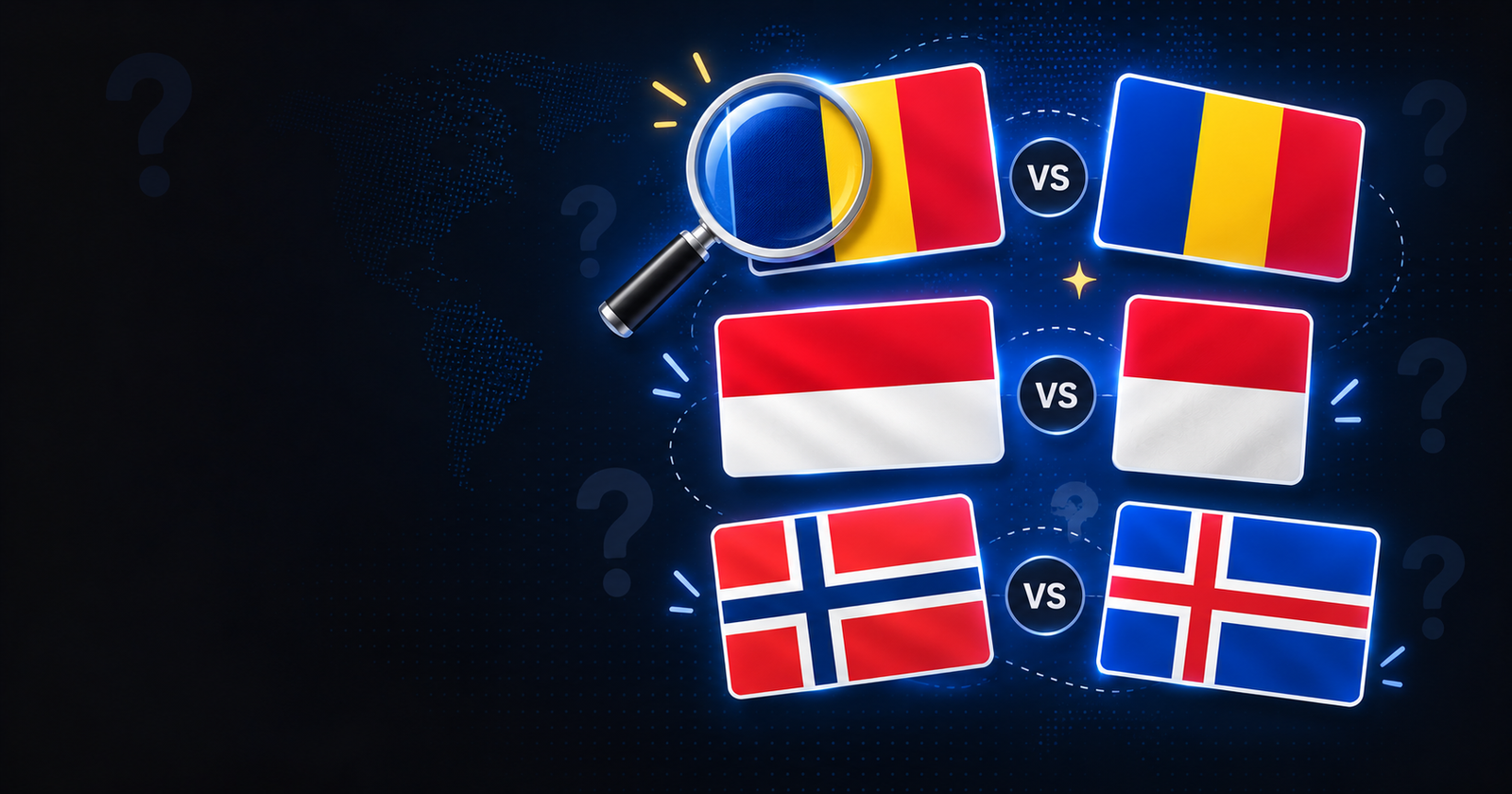
- Chad and Romania are almost identical blue, yellow and red stripes.
- Indonesia and Monaco are both red over white. Only the proportions differ.
- Ireland and Côte d'Ivoire use the same three colours in reverse order.
- Australia and New Zealand differ in the stars: white stars for Australia (plus a big one under the Union Jack), red stars outlined in white for New Zealand.
Guess the Flag hides a flag under six tiles and uncovers one per wrong guess, which forces you to recognise a flag from a corner or a stripe, a surprisingly good way to learn the details.
7. Little and often beats cramming
Memory research has said the same thing for over a century: you remember far more from short sessions spread over days than from one long session. Each time you recall something just as you were about to forget it, it sticks a little longer.
In practice this means five minutes a day is worth more than an hour on Sunday. It is the whole idea behind a daily quiz. Five questions, once a day, and a streak to keep alive is a small enough habit to keep up for months, and months is what it takes to know the world map properly.
8. Read the answer, especially when you get it right
After every question, take five seconds to read where the answer actually was and the short fact that comes with it. When you were wrong, this is obvious. When you were right, it is just as useful, because it turns a lucky guess into something you actually know.
A good fact gives your memory something to hold. You may forget that Srinagar is in the far north of India, but you are less likely to forget that it is famous for its houseboats on Dal Lake, and the fact brings the location back with it.
9. Mix up the kinds of questions
If you only ever practise capitals, you get good at capitals. Real knowledge of the world comes from seeing the same places from different angles: where they are, what their flag looks like, what their outline is, how many people live there, what happened there.
That is why we keep adding different games rather than more of the same. A week of the daily quiz, Guess the Country from its outline, the Map Quiz and Timeline will teach you more than a month of any one of them on its own. You can find all of them on the games page.
A simple plan for the next 30 days
- Every day: play the daily quiz and read every answer.
- Week 1: fix your anchor points and learn one continent's countries with their neighbours.
- Week 2: go through the capital traps above until none of them can catch you.
- Week 3: learn the flag families and the near-twins.
- Week 4: work on size and population with a few rounds of Higher or Lower.
Keep a note of your daily scores. Most players see their average climb within two weeks, not because they memorised more, but because their wrong guesses got closer. That is what being good at geography really looks like: not knowing everything, but always knowing roughly where to look.